
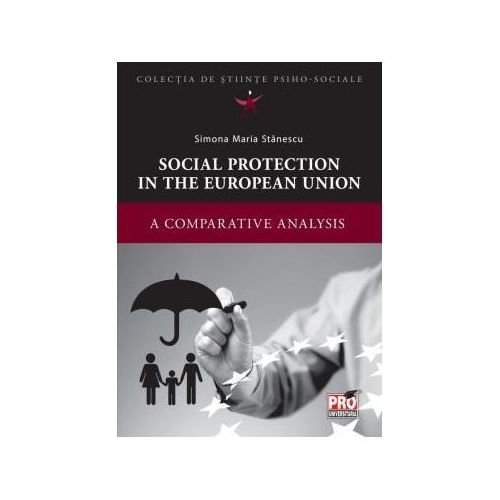
Social Protection in the European Union - Simona Maria Stanescu
26.43 RON
Continuous improvement of social protection coordination within the European Union (EU) towards providing a decent quality of life for all is supported by monitoring the national performances of the member-states alongside adjustments brought to the negotiation process with candidate countries.
The first part of the volume (Accession of Central and Eastern European countries) analyses the commitments assumed by the candidate countries that accessed the EU in the fifth wave (2004 and 2007) within the negotiation process. The chapter Implementing the acquis communautaire in the social area is an argument for researching the directions in which the social policy of the Central and Eastern European (CEE) countries developed together with the harmonization of the provisions contained by the acquis communautaire and analyses also the dynamics related to the negotiation of the latter, in particular of the chapter Social Policy and Employment. In the second chapter - Harmonization of the institutional framework in the social field – an overview is made about the impact of this process on the institutional building in the social field within the 12 CEE countries. The involved institutional stakeholders are considered, along with the institutional changes in the case of the social ministry, and the way in which the European years were reflected at institutional level. The series of institutional analyses for each of the 12 CEE countries is completed with comparative analyses. The purpose of the first part is to provide a discussion basis regarding the national efforts that the candidate countries make in order to be aligned to the EU Member-States.
The second part (Answers of the European Union to demographic challenges) provides information about the current population situation from the demographic viewpoint (see chapter: The population dynamics). Among factors influencing demographic trends, abortion was selected. The chapter Liberalization of abortion analyses measures adopted towards the prohibition and then liberalization of abortion among the EU-28 Member-States. The grounds for allowing abortion are overviewed as well as other related regulations. The chapter Changes of marital status analyses the marital statuses in 1991, 2003, and 2012 as well as the dynamics for the period 1991-2012. The lack of comparable information for all EU-28 countries about the entire period shaped the initial scientific purpose.
An obvious question in the context of the current demographic trends is: to what extent the family is (still) supported based on social protection measures The third part of the volume analyzes the social protection of the family by looking at family benefits with a special attention paid to maternity/ paternity leave.
The fourth part of the volume is dedicated to the anti-poverty measures focusing on unemployment benefits and minimum income guaranteed schemes. With respect to the latter, social protection systems in some EU member-states include unemployment benefits within minimum guaranteed resources while others provide a dedicated benefit (minimum income guaranteed).
The volume consists of a collection of articles published as part of the post-doctoral fellowship at the Research Institute for Quality of Life, Romanian Academy. The post-doctoral project analyses the impact of the member-state status within the EU on the national system of social protection. Based on the time allotted in this regard, three categories of countries were identified:
• six founder members of the EU: France (FR), Germany (DE), Italy (IT), The Netherlands (NL), Belgium (BE), and Luxembourg (LU);
• the following nine other “old” member-states: Denmark (DK), Ireland (IE), United Kingdom (UK), Greece (EE), Portugal (PT), Spain (ES), Austria (AT), Finland (FI), and Sweden (SW);
• 13 CEE new member-states:
o the two steps fifth EU enlargement wave: on 1st of January 2004: Cyprus (CY), The Czech Republic (CZ), Estonia (ET), Hungary (HU), Latvia (LV), Lithuania (LT), Malta (MT), Poland (PL), Slovakia (SK), Slovenia (SI) and on 1st of May 2007: Bulgaria (BG), and Romania (RO);
o the sixth wave: on 1st of July 2013: Croatia (HR).
Countries are enumerated in chronologic order when referring to the EU accession moment, in alphabetic order when referring to the European overview and additionally, by these three types of countries in the case of complementary in-depth analysis.
From the methodological viewpoint, the data processing was based on European databanks: Eurostat, the Mutual Information System on Social Protection of the Council of Europe (MISSCEO), and the Mutual Information system on Social Protection (MISSOC) data base of the European Commission, Directorate-General for Employment, Social Affairs and Equal Opportunities but also on the international ones: the Population Policy Data Bank maintained by the Population Division of the Department of Economic and Social Affairs of the United Nations ...
N/A