
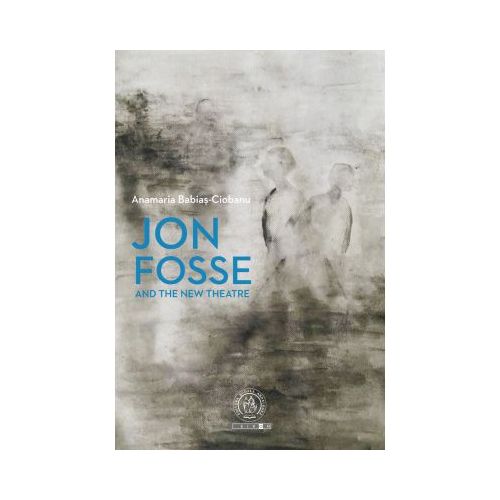
Jon Fosse and the new theatre - Anamaria Babias-Ciobanu
52.86 RON
Foreword by Sanda Tomescu Baciu
The volume was published in collaboration with Eikon Publishing House
The author's original, interdisciplinary perspective on Jon Fosse's drama is often audacious, but her research is conducted with skill and scientific circumspection. She draws certain metaphorical and intuitive connections between quantum physics and Jon Fosse's drama that later serve as investigative tools for the applied analysis of the selected plays by means of concepts such as entanglement, spacetime and so on. Right from the introduction and the first chapters, the working hypotheses are coherently and boldly correlated with the process of close reading as a chosen method of analysis. (Sanda Tomescu Baciu)
* * *
This book looks at Fosse’s plays as books to read, and the analysis will, in spite of the fact one identifies old themes like love, death, communication, relationships, betrayal, regret, suffering, remembering or childhood in Fosse’s plays, focus on the way one experiences each of these, as the Fosse’an perspective shines a new light on them. It is this sensibility and privilege that the reader is offered and that becomes even more personal as reading progresses. Moreover, when reading, one is connected to one’s past, so a return to the self (past self) happens, which can be an emotional experience. This is the case with any good literature, however, this is even more the case with Jon Fosse, since his literature urges the reader to intervene, to contribute with his/her own rhythm, breath and time in the pauses that are also a reflection on the information acquired and the experience just undergone. (Anamaria Babias-Ciobanu)
* * *
Table of Contents
About Jon Fosse and the Norwegian New Theatre (Foreword by Sanda Tomescu Baciu)
Introduction
JON FOSSE
THEORETICAL PRELIMINARIES
a revolution in science
what is time?
nearness
Bakhtin’s chronotope
ASPECTS OF THE FOSSE’AN DRAMATIC TEXT
the function of silence
the relevance of repetitions
Fosse and the st/age of postdramatic theatre
ceremonies
a poetic dramatic text
space
time
Fosse’an caharacters/ figures
uncertainty and the unknown?
Conclusion
CLOSE READING - THE PLAYS
And We’ll Never be Parted (Og aldri skal vi skiljast)
Sleep my Baby Sleep (Sov du vesle barnet mitt)
Introduction
Sleep my Baby Sleep, the play
Fosse’s characters/ figures
Plot, ceremony or Fosse’an dramatic process
Repetitions and Spacetime in Sleep My Baby Sleep
Space
Time
Text, communication and entanglement
Conclusion on the close-reading of Sleep my Baby Sleep
Fosse’s play Sleep (Svevn)
Shadows (Skuggar)
Introduction
The play
Shadows, figures or Fosse’an characters
Plot, ceremony or Fosse’an dramatic process
Text, communication and entanglement
Repetitions in building Time and Space
Conclusion on the close-reading of Shadows
Sea (Hav)
Introduction
Sea, the play
Fosse’an characters/ figures
Plot, ceremony in Sea
Repetitions and Spacetime in Sea
Text, communication and entanglement
Conclusion of the close-reading of Sea
Conclusion on the chapter
FINAL CONCLUSION
Bibliography
Appendix 1
Appendix 2. My Interview with Jon Fosse, 6th February 2015, Oslo
* * *
ANAMARIA BABIAS-CIOBANU, born on July 2, 1987 in Radauti, Suceava County, with a PhD in literature, is an author of several Scandinavian articles published in Romania, as well as the translator of the play Shadows by Jon Fosse (Umbre, Casa Cartii de Stiinta, 2015).
Among the published articles: Language and Identity in Norway (essay, Studia Universitatis Babes-Bolyai Philologia, vol 58, no. 2, pp. 167-176, 2013), A Short Example of Jon Fosse’s Dramaturgy. The play "Sov du vesle barnet mitt" (essay, Studia Universitatis Babes-Bolyai Philologia, vol 59, no. 1, pp. 87-99, 214), From Ibsen to Beckett: Aspects of the Human Condition (essay, Studia Universitatis Babes-Bolyai Philologia, vol 60, no. 1, pp. 133-147, 2015).
N/A